




Court Leader’s Advantage Podcast – September 16, 2025
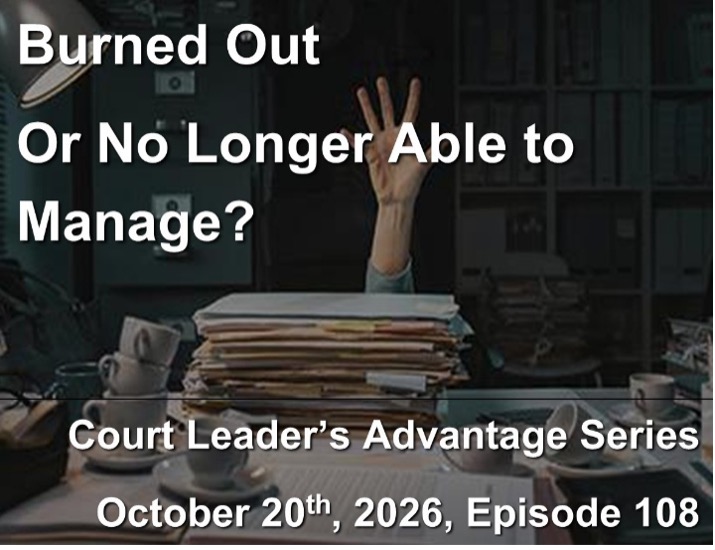
Employee disengagement is a critical national issue, one that quietly undermines productivity, economic growth, and workplace culture across the United States. According to a 2024 Gallup Corporation report:
- Only 33% of Employees are Actively Engaged in Their Work
- 50% are Not Engaged They are going through the motions without energy or passion.
- 17% are actively disengaged. They are, in some cases, sabotaging the efforts of their colleagues.
These statistics paint a sobering portrait of a workforce in quiet crisis, where a majority of employees are not fully invested in their works. Gallup estimates the cost of this disengagement to the U.S. economy at over $1.9 trillion annually lost in productivity, absenteeism, turnover, and diminished performance.
Managers point to employee shortcomings:
- Failure to Own Their Performance and Growth Many employees stop seeking challenges, feedback, or development. They become content to drift rather than drive.
- Lack of Effort to Connect with Their Job A weakened work ethic shows in a reluctance to go beyond the minimum or take full ownership of assignments.
- Misaligned Career Choices Some employees accept roles that don’t match their long-term goals and instead of course-correcting, allow dissatisfaction to quietly fester.
Employees, in turn, point to leadership:
- Lack of Clear Job Expectations Unclear responsibilities and vague performance standards create a fog of uncertainty, eroding confidence and consistency.
- Limited Opportunities for Growth When training, mentorship, and development are absent, ambition fades and potential withers.
- Not Feeling Cared About as a Person When empathy is missing, employees may feel invisible.
- Poor communication Both sides agree that communication is broken; each sees the other as responsible. Employees remain silent, withdrawn, and sometimes morose. Leaders misread the silence as apathy, not alienation.
What emerges is a workplace marked by quiet tensions and mutual disillusionment. Whether through micromanagement or complete detachment, the absence of meaningful feedback and recognition is deeply demoralizing. Can this be turned around before the silence becomes permanent?
Today’s Moderator
Erika Schmid, Judicial Clerk Supervisor at Multnomah County Circuit Court in Portland, Oregon
Today’s Panel:
Elaina Cano, Court Administrator, City Court, Surprise, Arizona
Teshrie Kalicharan Alternative Dispute Resolution Director, 9th Judicial Circuit Court in Orlando, Florida
Samantha Wallis Deputy Trial Court Administrator, Supreme Court, Coeur D’Alene, Idaho
Click here to listen to the podcast.
*Be sure to click on the subscribe button. It draws more attention to the topic of court administration on YouTube.*
Leave a question or comment about the episode at clapodcast@nacmnet.org.
Show Notes

Erika Schmid is the Judicial Clerk Supervisor at Multnomah County Circuit Court in Portland, Oregon. She started as a legal assistant at a public defense office and began her journey at the courthouse by being a judicial clerk. Erika was introduced to NACM very quickly upon becoming a supervisor as she attended the Minneapolis mid-year conference in 2023, just two months after she started her new position.
Going to this NACM conference opened her eyes to all the wonderful possibilities of being involved in the court system and she quickly joined the Early Career Professionals committee meetings to learn more and make connections

Elaina Cano is a seasoned court administrator with over 20 years of experience in judicial administration, 19 of which have been in leadership roles across both the Superior and Municipal Court systems. She brings a deep and well-rounded understanding of court operations, policy implementation, and strategic leadership in the justice sector. Elaina holds an Associate’s degree in Legal Studies, a Bachelor’s degree in Business Management, and a Master’s degree in Public Administration. Her academic foundation, combined with two decades of hands-on leadership, has positioned her as a transformative leader known for operational excellence, organizational development, and a commitment to public service. Throughout her career, Elaina has led high-impact initiatives focused on access to justice, process efficiency, and staff development. Her leadership journey has been defined by navigating complex challenges, collaboration, and mentoring future leaders in the judicial branch. Her legacy is rooted in integrity, innovation, and a steadfast dedication to advancing court performance and community trust.
 Samantha Wallis has been working for the Idaho courts since 2017 and has been the Deputy Trial Court Administrator for the First Judicial District since 2022. During her tenure in the Trial Court Administrator’s office, Samantha has been onboarding new employees in specialty courts including family court service employees, treatment court coordinators, law clerks, and assists with onboarding new judges as well.
 Teshrie (Tess) Kalicharan is currently the ADR Director for the Ninth Judicial Circuit Court of Florida. She is a Florida Supreme Court certified county and family mediator, primary county mediation trainer, and qualified arbitrator. She was previously appointed to serve on the Florida Supreme Court’s Mediator’s Rules and Policy Committee. She is also a NACM Core Champion and NCSC Certified Court Manager. Most recently, Teshrie is also a NACM Board of Directors and is co-chair on NACM’s ECP Committee and second co-chair on the Membership Committee.
Court Leader’s Advantage Podcast – September 16, 2025
Employee disengagement is a critical national issue, one that quietly undermines productivity, economic growth, and workplace culture across the United States. According to a 2024 Gallup Corporation report:
- Only 33% of Employees are Actively Engaged in Their Work
- 50% are Not Engaged They are going through the motions without energy or passion.
- 17% are actively disengaged. They are, in some cases, sabotaging the efforts of their colleagues.
These statistics paint a sobering portrait of a workforce in quiet crisis, where a majority of employees are not fully invested in their works. Gallup estimates the cost of this disengagement to the U.S. economy at over $1.9 trillion annually lost in productivity, absenteeism, turnover, and diminished performance.
Managers point to employee shortcomings:
- Failure to Own Their Performance and Growth Many employees stop seeking challenges, feedback, or development. They become content to drift rather than drive.
- Lack of Effort to Connect with Their Job A weakened work ethic shows in a reluctance to go beyond the minimum or take full ownership of assignments.
- Misaligned Career Choices Some employees accept roles that don’t match their long-term goals and instead of course-correcting, allow dissatisfaction to quietly fester.
Employees, in turn, point to leadership:
- Lack of Clear Job Expectations Unclear responsibilities and vague performance standards create a fog of uncertainty, eroding confidence and consistency.
- Limited Opportunities for Growth When training, mentorship, and development are absent, ambition fades and potential withers.
- Not Feeling Cared About as a Person When empathy is missing, employees may feel invisible.
- Poor communication Both sides agree that communication is broken; each sees the other as responsible. Employees remain silent, withdrawn, and sometimes morose. Leaders misread the silence as apathy, not alienation.
What emerges is a workplace marked by quiet tensions and mutual disillusionment. Whether through micromanagement or complete detachment, the absence of meaningful feedback and recognition is deeply demoralizing. Can this be turned around before the silence becomes permanent?
Today’s Moderator
Erika Schmid, Judicial Clerk Supervisor at Multnomah County Circuit Court in Portland, Oregon
Today’s Panel:
Elaina Cano, Court Administrator, City Court, Surprise, Arizona
Teshrie Kalicharan Alternative Dispute Resolution Director, 9th Judicial Circuit Court in Orlando, Florida
Samantha Wallis Deputy Trial Court Administrator, Supreme Court, Coeur D’Alene, Idaho
Click here to listen to the podcast.
*Be sure to click on the subscribe button. It draws more attention to the topic of court administration on YouTube.*
Leave a question or comment about the episode at clapodcast@nacmnet.org.